The challenge
Jewellery catalogues run to a thousand images and beyond, and the design a customer wants is one of them. Inside the ERP, finding it meant scrolling — page after page of near-identical rings and chains, with the right answer recognisable on sight but impossible to search for in words. A jewellery ERP platform came to us to solve that for their own customers, as an add-on to the system those customers already used every day.
Our approach
We built the system from scratch as a multi-tenant platform. Each of the ERP's customers gets their own tenant, holding their own catalogue and their own trained model — so one jeweller's designs never surface in another jeweller's search results, and no tenant's data trains anyone else's model.
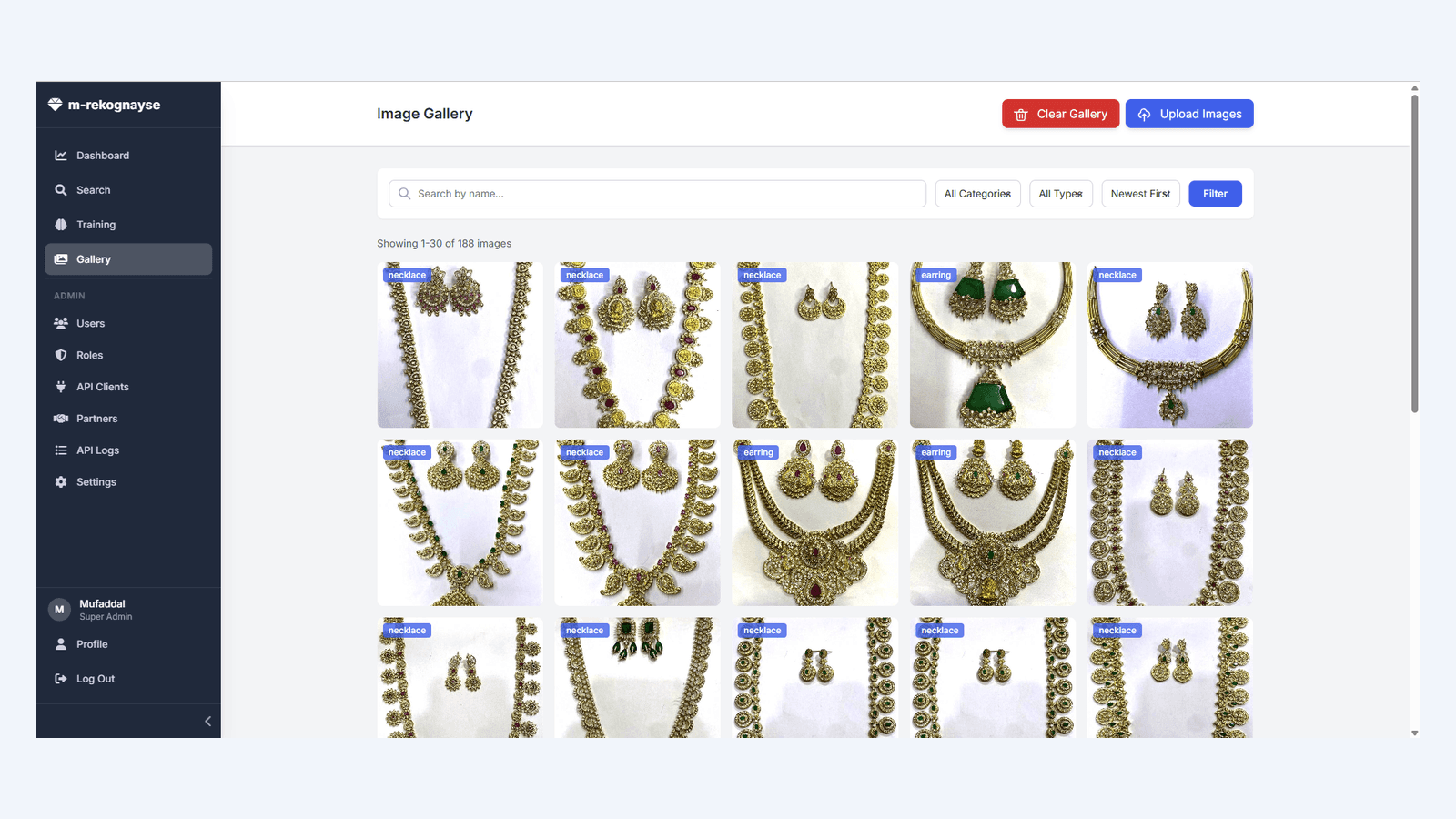
Training runs on the catalogue a customer already has. They point the system at an existing image set — a server folder or a shared Drive — and a model is trained on it. Every image becomes a vector held in Qdrant, so a search is a similarity query against the customer's own designs rather than a keyword guess. No manual tagging, no describing a design in words that were never going to capture it.
The matching service is a FastAPI application, kept separate from the Laravel and Vue 3 admin the operators work in. That split matters: the ML service scales on its own terms, and the interface around it — training runs, gallery, tenants, API clients, request logs — evolves without touching the model.
Search is exposed as a token-authenticated API rather than a screen. The ERP calls it with an image and gets ranked matches back from that tenant's dataset, with a similarity threshold the operator sets and jewellery-type filters to narrow the field. Token auth scopes every call to a single tenant, which is what makes one deployment safe to sell to every customer on the platform.
The outcome
The ERP platform can now offer visual search as an add-on across its existing customer base, from one system rather than one integration per client. For the people using it, finding a design changed from scrolling a catalogue to querying it — the search takes an image and answers in kind.
Built end to end for a partner who resells it: tenant provisioning, model training, and a token-secured search API — an AI capability their customers reach through the ERP they already work in, rather than another tool to learn.