The challenge
An enterprise group was running its accounting and tax operations on a legacy system that had stopped keeping up. The scale is the first problem: 170 departments submit into it. The second is that the work itself is unusually intricate — each department submits through four separate flows, every one with its own rules, states, and settlement path, and all of them have to end in a payment that reconciles back to the submission it came from. Nothing about it is generic. The business process is the product, and it had to be rebuilt exactly, without pausing an operation that runs on it daily.
Our approach
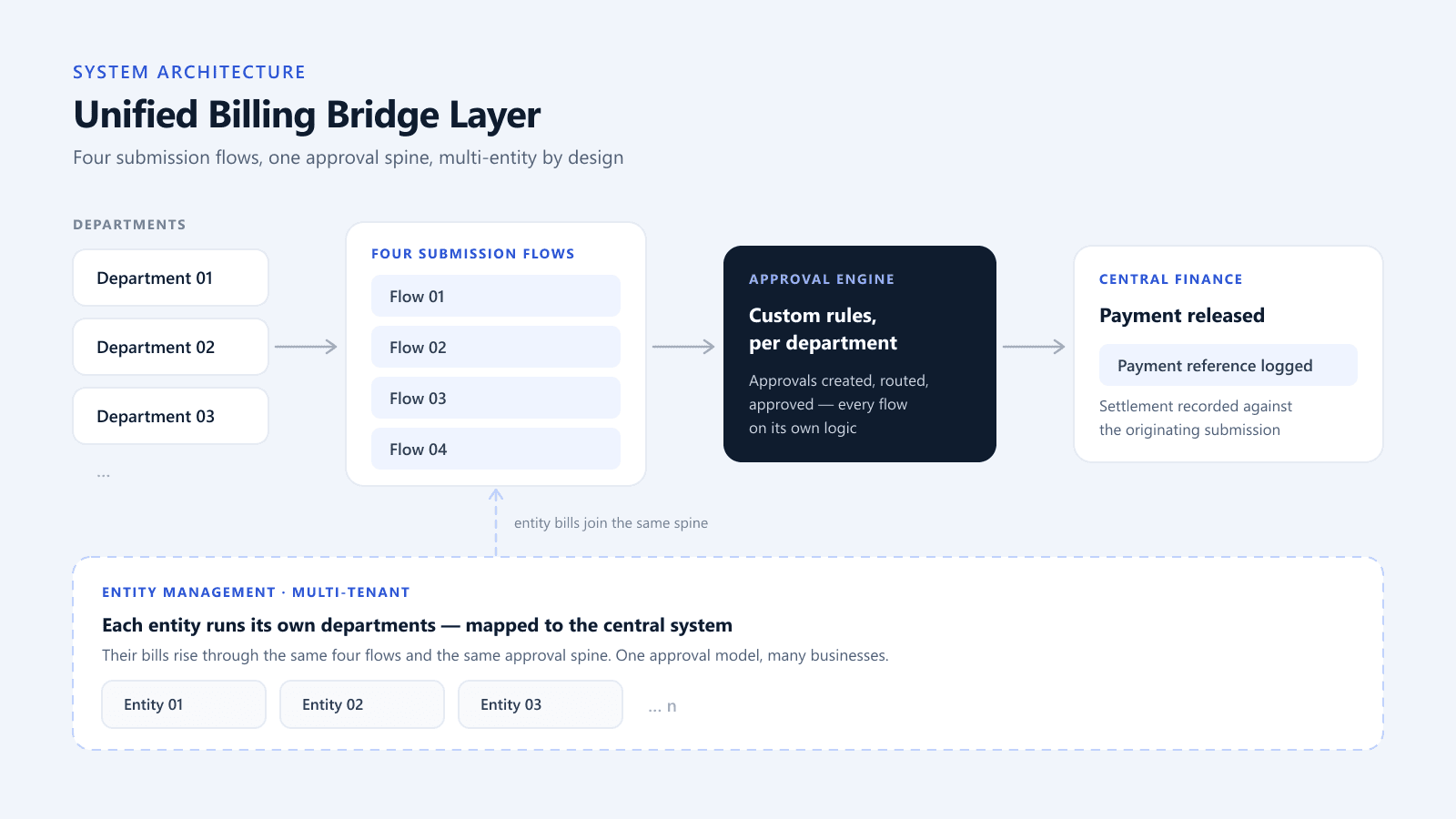
We rebuilt the system on Laravel, modelling the four submission flows as first-class paths rather than variations of one. Each carries its own validation, its own approval rules, and its own route to settlement — because in practice they behave like four different products that happen to share a ledger.
Approval is where the complexity concentrates. A submission passes through a five-stage chain, and the rules are department-specific: what it needs, who signs it off, and in what order changes depending on where it originated. Across 170 departments that is not a set of branches anyone should hard-code, so we built it as a configurable spine — a change in policy is a change in configuration, not a release.
Settlement closes the loop. When central finance releases payment, the reference is logged against the originating submission, so every rupee that leaves is traceable back to the department, the flow, and the approval chain that authorised it.
Above all of that sits what we call the Unified Billing Bridge Layer — a multi-tenant Entity Management system. The parent business creates entities, each with its own departments, mapped onto the central structure. Their submissions rise through the same four flows and the same approval spine. One approval model, many businesses, no second system to maintain.
The outcome
The group runs its accounting and tax operations on a system built around how it actually works, rather than working around a system built for someone else. A single one of the four flows has settled more than ₹117 crore through that five-stage chain. The entity layer means growth — a new business, a new department — is configuration rather than a development project.
The most complex system we have built. Most of it we cannot show you: the screens carry live financial data for an organisation that requires confidentiality, so what is published here is the architecture, which is ours to describe. If you are evaluating us for work of this kind, that constraint is itself the reference.